
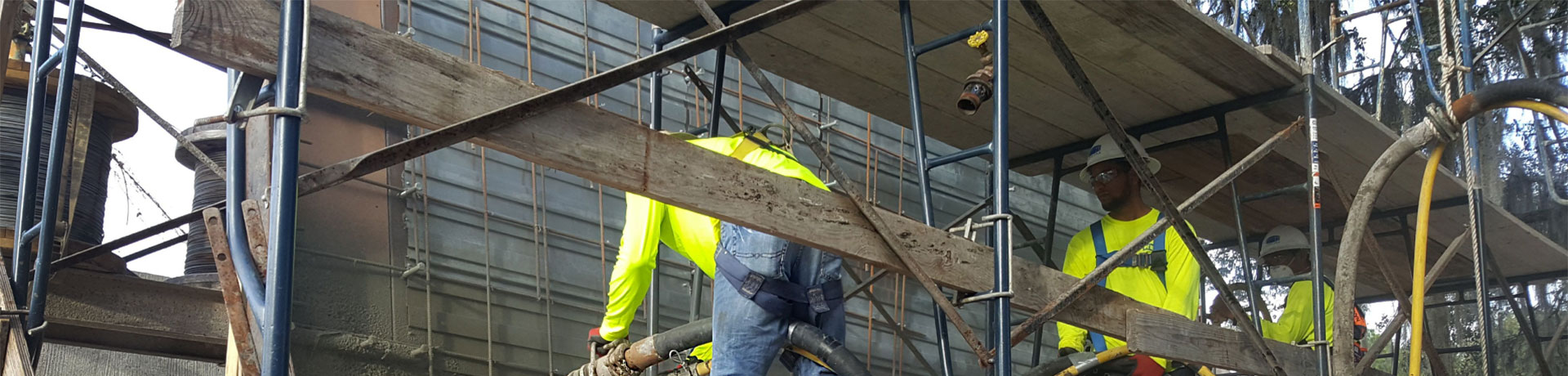
Washington State’s Capitol Seismic Repair

Washington State’s Capitol Seismic Upgrade will surely rank as one of the top restoration projects of this decade and shotcrete proved to be essential to its success. As with most complex rehabilitations, many of the hurdles faced arose after the project had begun. The ability of the contractors, engineers, and architects working together to overcome these issues proved once again to be the crucial factor in the success of the project.

Shotcrete Foundation Walls at the Smithsonian Portrait Gallery in Washington, DC

The National Portrait Gallery, located on the campus of the Smithsonian Institution in Washington DC, is one of the oldest government buildings in that historic city. It was the original location for the U.S. Patent Office and it was used as the site of the inaugural ball celebrating the election of Abraham Lincoln in January 1861. When a recent renovation and expansion project was started on the building, shotcrete was selected as the material of choice

The Jardin Zoologique Project Experience

An extension to the Quebec City Zoo in Quebec City, Canada, will incorporate over 100 acres of new landscaping that will house more than 500 animal species from five different continents. The Jardin Zoologique construction project will host a new zoological garden that will be used to exhibit a spectacular expansion of its bird collection as well as an accentuation and harmonization of its horticultural infrastructures. The architects on the project (a European and Quebec collaboration) are specialists in the field of architectural shotcrete and were asked to investigate various available options for the design of the architectural exhibits of this important new zoo expansion. Atelier Artistique du Béton

Concrete Domes- A Flexible Building Solution for the 21st Century

Although concrete domes have been around for a long time, they are still sometimes considered as unique or unusual structures. Insulated concrete domes have been built for a multitude of uses for many years throughout the world. An interest in concrete domes for architectural applications, however, has not been as great as for industrial domes, but that is changing. Domes provide tangible benefits”safety, durability, and economy”features which are desirable in all structures no matter what their shape. So why are domes now becoming the shape of the future?

Architectural Shotcrete for Residential and Commercial Development

Architectural shotcrete can be used to enhance the environment of almost any type of project, from backyard pool areas and dramatic rock and water entry features to world-class theme parks like Disneyland and Universal Studios. The versatility, strength, and durability of shotcrete can be combined with the natural appearance of rockwork to make a visually pleasing structure in a natural setting.
The use of shotcrete to create natural looking rockwork originated more than three decades ago. One of the earliest uses was in the creation of artificial boulders for use in museum exhibits in the Southwest. This type of work then evolved into the creation of rock and water features for residential swimming pools to enhance the surrounding hardscape with natural looking, sculpted rock features.
In residential applications, skilled craftsmen work alongside the shotcrete crew while the pool shell is constructed. Depending on the size of the feature, a steel mat is tied into the reinforcing cage of the pool using No. 3 reinforcing bar at 6 in. (15 cm) on center. As the pool is shotcreted, a mound in the rough shape of the feature to be constructed is shot simultaneously. This mound can then be shaped and sculpted by the rock crew until the desired shape and form is achieved. Once that is accomplished, the shotcrete is slick- toweled and then covered with the necessary material used to give the shotcrete a texture similar to natural stone.
Because of the structural characteristics of shotcrete and the natural look of sculpted rock, the project possibilities are endless. This has opened the door to projects incorporating caves, playgrounds, slides, and retaining walls in both residential and commercial settings. As these features become larger and more complex, the structural aspect becomes more significant. Structural ledges and overhangs can be con-structed so that water flows over, but can be walked under. Caves can be constructed within the rockwork so that pumping equipment can be housed, protected, and hidden. This type of feature can be constructed by using No. 3 rein-forcing bar at 6 in. (15 cm) on center. A heavy metal lath is placed on the underside of the

Artistic Shotcrete for a Historic Auditorium

The Goetheanum (Fig. 1) in Dornach, near Basel, Switzerland, was constructed in the late 1920s from a design by Austrian social philosopher and œspiritual scientist Rudolf Steiner. This building represents the first use of reinforced concrete for monumental, sculptured forms.

Shotcrete Lions for Calgary’s Centre Street Bridge

The Goetheanum (Fig. 1) in Dornach, near Basel, Switzerland, was constructed in the late 1920s from a design by Austrian social philosopher and œspiritual scientist Rudolf Steiner. This building represents the first use of reinforced concrete for monumental, sculptured forms.