
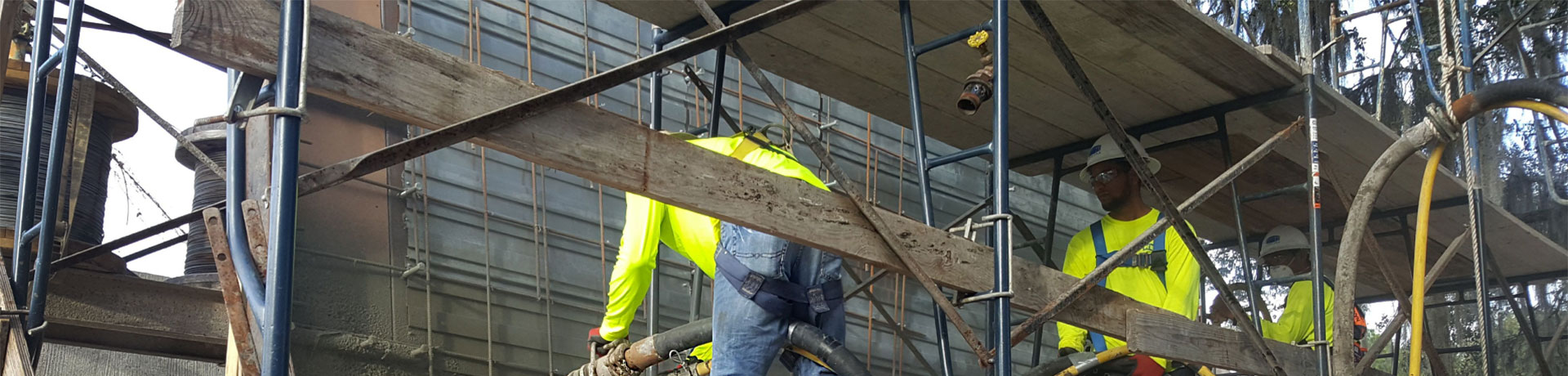
Shotcrete would be an excellent process to repair or overlay your wall. You are correct in saying that it could not only repair but also reinforce and enhance the strength of the wall system. It is important to remove all deteriorated brick and sandblast or water-blast the surface if you are looking for a good bond between the shotcrete and the existing brick. Dowels epoxied or grouted into the existing brick are often used to mechanically tie the shotcrete overlay to the brick wall and also stabilize the new reinforcing steel in the shotcrete overlay.
Can shotcrete be used to repair a wall made of cement and fly ash? If so, should the wall be prepared for the shotcrete application?
Structurally sound concrete that contains up to 20% fly ash in the total cementitious materials should not present any problems for subsequent bonding of shotcrete. Concrete with fly ash contents up to 30% have been used in recent years without any reported problems with strength and bond. Although concrete mixtures with higher levels of fly ash (up to 55%) have been proposed, we don’t have direct experience with their bonding characteristics. We suspect it would be fine as long as the base concrete develops adequate compressive and tensile strength. This could be confirmed by a simple bond strength test of shotcrete on the concrete substrate in question.
The existing surface needs to be properly prepared, removing all soft or deteriorated material back to sound concrete. For extensive defects in the existing concrete, chipping hammers may be required. For removal of light surface carbonation or laitance, a strong, high-pressure water blast or sand/bead blasting may be adequate. Depending on the thickness of the shotcrete, reinforcing may be required in the overlay. Specific details of the repair are best developed by an engineer experienced in shotcrete repair.
We are studying a repair to an existing large-diameter corrugated metal pipe. The owner requires that the repair meet the fifth edition of the AASHTO LRFD Bridge Design Specifications with 2010 Interim Revisions. We want the owner to consider shotcrete as opposed to installing a new carrier pipe. I have pipe dimensions, depth, and so on, but need some help deciding if this is practical.
Shotcrete has been used in many cases to repair, rehabilitate, and strengthen pipes, culverts, and tunnels. It is not uncommon to use shotcrete to strengthen a culvert under a highway or roadway section. Shotcrete is a method of placing concrete at a high velocity. The shotcrete placed inside the existing pipe can be designed for strengths from 4000 to 10,000 psi (27.5 to 69 MPa), depending on the amount you are willing to spend on the shotcrete products. We cannot speak to the acceptance by the governing body, but it has been done successfully and often in the past. It is vitally important that the shotcrete contractor be competent and experienced in installing the lining. Your specification should require evidence of similar previously completed projects with current references.
We are rehabilitating a limestone-brick masonry storm sewer by lining it with shotcrete. The sewer is approximately 7 ft (2.1 m) tall with an arch ceiling and walls that are 8 ft (2.4 m) apart. The limestone surface is fairly rough, but the brick portions are not. While the existing structure shows no signs of needing to be reinforced for structural support, we are reinforcing to prolong the service life of the culvert. Is there a recommended minimum shotcrete thickness and reinforcement?
Shotcrete has been used to successfully rehabilitate sewers for over 50 years.
The thickness to be used is an engineering issue and beyond the scope of our association. We would recommend a 2 in. (50 mm) minimum thickness reinforced with either polypropylene fibers or a light-gauge welded wire reinforcement. The surfaces must be cleaned thoroughly to remove grease, oils, and other substances deleterious to good bond. Bonding to brick is not a problem.
Finish is another consideration. The added liner thickness will reduce the size of the culvert. If capacity is not an issue, it is recommended to leave the new shotcrete lining with a nozzle finish. If capacity might be a problem, then a float or trowel-smooth finish may be necessary.
We are removing up to 0.75 in. (19 mm) of the existing scaled concrete on a fire-damaged concrete wall. The architect has asked if shotcrete is applicable for a vertical 0.75 in. (19 mm) application. Also, the walls are circular and the working distance from the wall is no more than 36 in. (0.9 m). Is this enough room to apply shotcrete?
Yes, shotcrete can be applied in a 36 in. (0.9 m) area. Keep in mind, however, that it’s difficult to get as nice a gunning pattern as you would like when you are that close to the receiving surface. When you cannot back off from the wall, there is a tendency for a more irregular gunning surface, which would require more cutting and screeding to get an aesthetically pleasing result.
Our current project is a pier with severe corrosion of reinforcement and obvious spalls. The work will all be overhead with the surface 18 in. (457 mm) above the mean tide level and, for a variety of reasons, dry-mix is not an option. We are looking for a good, dense, wet-mix design for saltwater marine exposure. Compressive strengths need to be in the mid-range of 7000 to 8000 psi (48.3 to 55.2 MPa).
For a potentially suitable wet-mix shotcrete mixture design for marine structure repair, go to the ASA Web site (shotcrete.org). Click on Shotcrete magazine and search for “Shotcrete Classics: Deterioration and Rehabilitation of Berth Faces in Tidal Zones at the Port of Saint John.” This mixture design worked well for over 1.2 miles (2 km) of ship berth face repair over a 10-year period. Note: Because of high freezing-and-thawing exposure, the shotcrete was required to be air entrained. While the original mixture design called for 7% air content as shot, it was subsequently modified to require an air content of 7 to 10% as batched (at the point of discharge into the shotcrete pump) and an air content of 5 ± 1.5% as shot (into an air pressure meter base). Such shotcrete has provided good freezing-and-thawing resistance. You should be aware that your local materials (coarse and fine aggregates and cement) may have different properties in the concrete mixture, however, as compared to the mixture discussed in the article. It is recommended that a local engineer, testing laboratory, or concrete supplier be retained to develop a concrete mixture using local materials that meets the performance requirements of the mixture design mentioned in the article. Also, test panels constructed with the mixture, nozzlemen, and equipment to be used in the shotcreting are highly recommended to verify the strength performance of the shotcrete.
We’re looking at adding approximately 4 in. (100 mm) of shotcrete to an existing 8 in. (200 mm) wall to meet new load requirements. What’s the minimum cover between the reinforcement and existing wall for proper encapsulation of the reinforcement?
A minimum clearance for the reinforcment off the existing surface should be 0.75 in. (19 mm) or one bar diameter, whichever is greater, to allow a good flow of material around the reinforcing steel.
We are repairing a culvert in Dallas, TX. The concrete wall of the structure is prematurely disintegrating. We are considering a process to temporarily support the ceiling, remove the wall, place a form on one side, and use shotcrete to replace the wall. Does this sound like a reasonable use for shotcrete? What kind of specifications should be used?
Yes, this sounds like a good use of the shotcrete process. Your sequence sounds like a good plan. A sample Structural Shotcrete Specification is available from the Shotcrete magazine archive on the ASA Web site (www.shotcreteweb.wpengine.com/).
I have a seawall with a gunite (dry-mix shotcrete) outer layer. The gunite layer has cracked in multiple locations on the seawall resulting from years of exposure to the harsh environment. The original gunite was not part of a soil nail system. I am considering a re-coat of shotcrete probably 3 to 4 in. (76 to 100 mm) thick with wire mesh and L-anchors on a 2 to 3 ft (0.6 to 0.9 m) grid. I know the importance of surface treatment for bonding, etc., but I am not sure if I should remove the original gunite layer (which is still sound in some places) or apply the re-coat. The new overlay needs to be structurally effective. I know that a soil nail system is the most dependable solution, but cost is a major concern. Do you have any suggestions?
The new shotcrete layer can be added to the existing shotcrete or installed after the existing shotcrete is removed. The decision to remove or not remove the existing shotcrete is beyond the scope of what we can comment on. If the existing shotcrete is left in place and overlayed, it should be thoroughly cleaned and roughened to create a good bonding surface. Because this is in a marine environment and you are considering the use of wire mesh, you need to make the new layer thick enough to have sufficient cover on the reinforcing steel. Alternately you could consider the use of fiber-reinforced shotcrete and silica-fume-enhanced fibrous shotcrete. Please note that there are many types of fibers on the market. We recommend that you review some of the Shotcrete magazine articles on fibrous shotcrete and on shotcrete in a marine environment on the ASA Web site. We suggested two papers for reference. The first is by Gilbride, Bremner, and Morgan on the Port of Saint John, and the other is by Morgan on the use of fibers that cover marine repairs. You mentioned using “L-anchors” at 2 to 3 ft (0.6 to 0.9 m) spacing. The use of grouted anchors with a reasonable embedment is quite common, but the design of such anchors is again beyond the scope of what we can advise.
Our client has a retaining wall that has experienced movement in the precast concrete panels and has asked us to research a product that could be applied to give a smooth look to the retaining wall. Is shotcrete a possible option? I would also like information on the recycled content of shotcrete.
Shotcrete is basically concrete that is pneumatically applied. Shotcrete can be used as an overlay for an existing wall to provide structural strengthening and a smooth look. Again, we suggest that you visit ASA’s Web site and search previous Shotcrete magazine articles for finishes. Before the shotcrete is applied, the wall must be stabilized from any anticipated future movement. Relatively thin layers of shotcrete or concrete will not withstand future wall movements without distress and cracking. The recycled content of most shotcrete mixtures is limited to the substitution of fly ash or other pozzolans for a percentage of the cement in the mixture. To properly place shotcrete, this substitution is generally limited to approximately 25% of the cement content.