
I remember doing a job in San Francisco, CA, about nine or ten years ago. The job consisted of building a basement in an existing commercial area. There were buildings on both sides of the new proposed basement. The construction called for the new basement walls to be built on the property line with a 2-in. foam spacer”the perfect shotcrete job!
Safety Shooter : Create a Pre-Site Checklist
Whenever possible, try to pre-site all construc-tion projects before scheduling personnel and equipment. A little extra planning ahead of the actual work can save a lot of headaches later on.
Safety Shooter: Always Use Protection
About fifteen years ago, we had a project that involved doing some extensive shotcrete (dry process) window infills. The job required shooting from the inside of the building onto plywood forms and involved about 5 stories of window.
Scaffolding
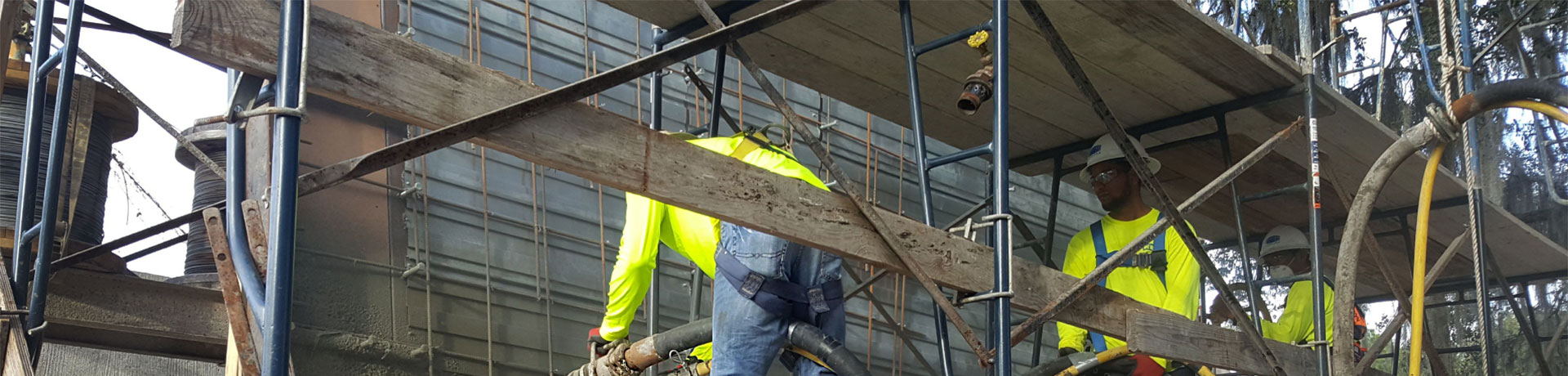
Scaffolding, in my opinion, could be listed as the #1 item on a top ten safety checklist. I believe it becomes 50% more difï¬ cult to work safely and properly on scaffolding than on the ground. Shotcreting using the dry-mix process is much easier to handle because of the weight of the hose, and
Safety Glasses
A crane operator, carpenter, baseball player or a shotcrete crew? Probably everyone listed should use them. On a scale of 1 to 10, the shotcrete crew would rate a 10 with need. œWho on the crew should wear them? I asked one of my superintendents, she said, œThat™s easy, everyone on the crew. The nozzleman and air lance man for obvious reasons, but also the pump operator and potman to protect themselves from dust and shotcrete overspray and rebound. The finishers also need eye protection from constantly working vertical concrete surfaces. The laborers also need protection from rebound, dust and overspray, and the occa-sional burst hose or coupling!
A shotcrete operation requires several high-pressure pieces of equipment, all of which, unfortunately, can burst. The dry-mix
Cheap Insurance
Cheap Insurance: Most of us in the shotcrete industry have had a plugged hose creating either a dust storm with the dry process or concrete over-spray everywhere with the wet process. When a hose is plugged, it has been my experience that everybody on the crew starts yelling and running toward the operator. Communication between the nozzleman and the gun/pump operator is one of the most important and critical links on the job for productivity, and most of all, safety for everyone. Unfortunately, because of different job site layouts, continual rotation of people, and equipment movement on and around the job site, good communication is often difï¬ cult to achieve or maintain.