
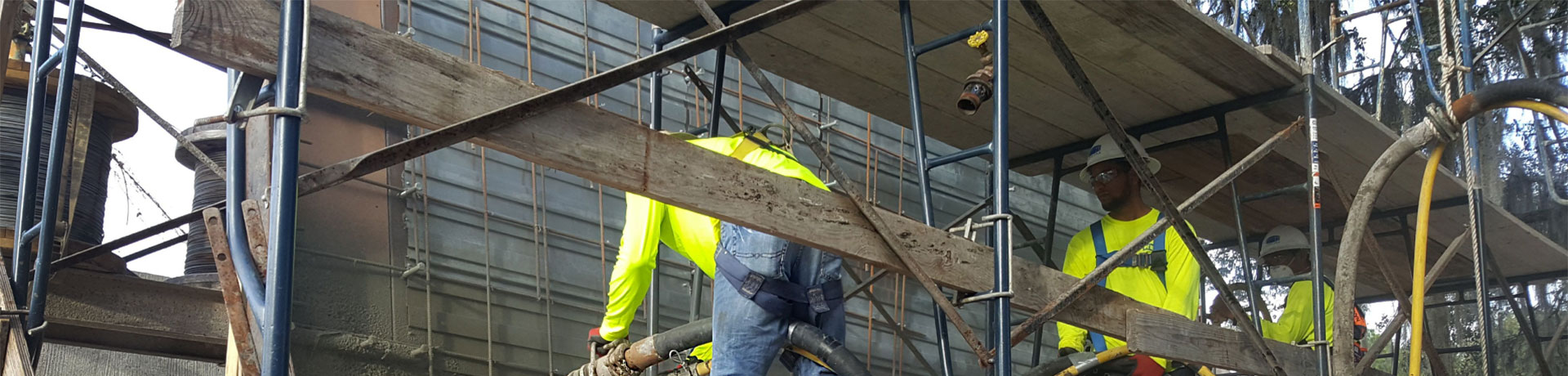
This article touches on both wet- and dry-mix shotcrete equipment maintenance that is not typically in the owner™s manual. Equipment manuals for the dry- and wet-mix machines have a section on maintenance that tells you what to grease and check on a daily basis. Wet-mix shotcrete pump manuals will have a section on oil and filter changes needed at designated running hours.
Quality and Shotcrete
Many factors affect the quality of shotcrete. The shotcrete process itself provides a unique and effective placement technique for portland cement concrete. For the shotcrete process to yield the highest possible quality product, however, many factors must be considered. The shotcrete process has both obvious and not-so-obvious factors that affect the quality of the end product.
Respiratory Protection
Answer: Respiratory illness can take years to develop. As with smoking, the delayed but high-risk results sometimes make it difï¬ cult, crucial, to convince employees to wear respi-rators in certain environments, even if the air does not appear to be harmful. The key to convincing employees to protect themselves is to educate them on the hazards present in the workplace and the effects on the human respiratory system.
ASA Mega-Demo Hits the Jackpot
The American Shotcrete Association (ASA) and Hanley Wood teamed up to present a shotcrete extravaganza in Las Vegas, Nevada, during the 2005 World of Concrete. Encouraged by the successful Mega-Demo in 2001, the leadership
The Changing Job Site
We all know job-site conditions can undergo constant changes. The best safety tip for these changing job-site conditions is to check all job sites before crews are dispatched. This inspection will take a little time and may be a little inconvenient, but after the inspection you will have an understanding of what potential hazards are present for your
U.S. Shotcrete Standards Update
Much has happened since the last update on the activities of various shotcrete organi-zations and committees in the Summer 2004 issue of Shotcrete. Probably the most important, at least to this author, is that I have retired from full-time employment from SI Concrete Systems and will consult in the industry if anyone will put up with me. I plan to continue my work with the various organizations discussed below. Readers are requested to contact the editor and author if inaccuracies are found or if additional activities should be reported.
Safety Shooter : Working Safely in Cold Weather
Once again the frost is on the pumpkin by guest author and Old Man Winter is at the door. With Todd Bennett less daylight and colder temperatures, we need to adjust our safety programs from avoiding heat exhaustion, dehydration, overexposure, and sun-related illnesses to preparing our ï¬eld crews to deal with the other extreme.
Safety and Common Sense
Often when the subject of safety is brought up, we start thinking of regulations, special protective equipment, programs, inspections, reporting, meetings, insurance, and so on. Common sense tells us that it is in our best interests to have good safety practices and to enforce company safety policies. However, sometimes our attitude toward safety is not very positive, treating safety programs and policies as a necessary evil rather than a critical part of daily operations. Having a safe work place starts with instilling a positive attitude in all employees. Doing even the simplest things safely creates an atmosphere that tells employees that the company is concerned about them beyond what is required by law.
Let™s look at two examples”one obvious, and one less apparent:
Innovative Synthetic Fibers
After four years of research and development on improving the bonding capabilities of synthetic ï¬bers, we recently patented a high-tensile-strength synthetic ï¬ber that partially ï¬brillates upon mixing and shooting, increasing its ï¬nal surface area and bonding capabilities to the concrete.1 The ï¬bers are introduced into the concrete mixer as monoï¬lament units of relatively low surface area (F4-a in Fig. 1), allowing up to 2% vol. (18.5 kg/m3 [31.2 lb/yd3]) ï¬ber dosages. During the mixing process, each ï¬ber transforms into a unit having several ï¬brils at its ends (F4-b in Fig. 1). The ï¬brils anchor each ï¬ber so their bonding capabilities are superior to those of
Waterproofing Your Shotcrete Tank
When it comes to preventing water damage and preserving the integrity of concrete structures, waterprooï¬ ng is essential. In of concrete tanks, however, effective, reliable waterprooï¬ ng is especially critical. Concrete tanks play a vital role in many communities. They function as drinking water containers, wastewater treatment plants, and water storage reservoirs. Not only is a leak in a facility like this expensive and time-consuming to repair, it can be inconvenient and even dangerous to the community.