
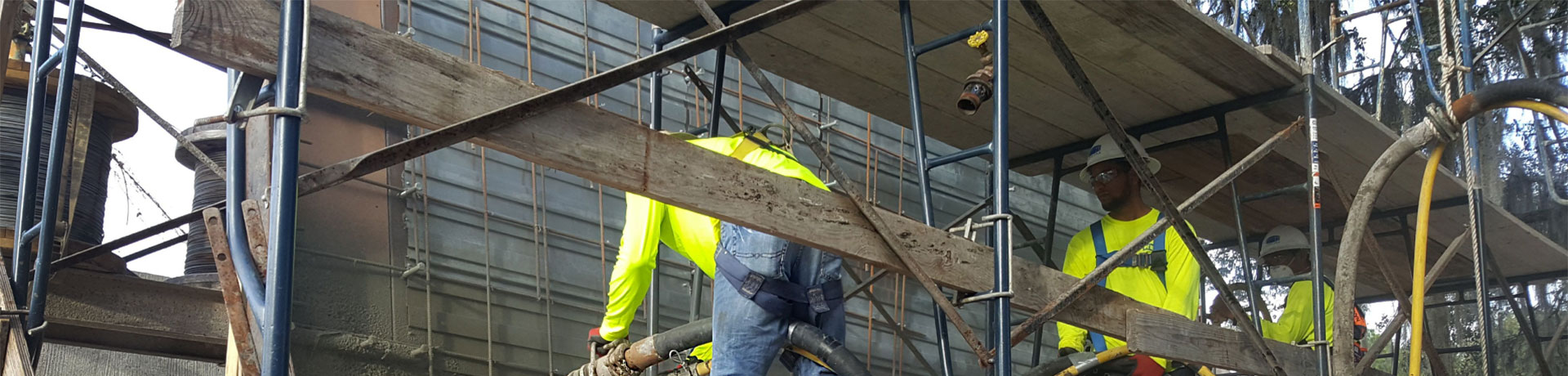
UMA was contacted in January 2021 regarding a residential pool in Winston-Salem, North Carolina that was experiencing settlement issues in the shallow end. Prior to UMA’s involvement, Catawba Valley Engineering & Testing (CVET) conducted soil test borings at the property to determine the in-situ soil conditions.
Outstanding Repair & Rehabilitation Project
Project Name:
Replacement of Flume 4/5/6 and 30
Location:
Pollock Pines, CA
Shotcrete Contractor:
Dees Hennessey, Inc
Architect/Engineer:
GHD Inc
Material Supplier/Manufacturer:
Folsom Ready Mix & The Quikrete Company
Equipment Manufacturer:
REED Concrete Pumps
General Contractor:
Syblon Reid
Project Owner:
El Dorado Irrigation District
Outstanding Underground Project
Project Name:
Exchange Place Station – 9 Car Program West Corridor
Location:
Jersey City, NJ
Shotcrete Contractor:
Patriot Shotcrete, LLC
Architect/Engineer:
WSP USA, Inc.
Material Supplier/Manufacturer:
Eastern Concrete Materials
Equipment Manufacturer:
Western Shotcrete Equipment, Inc.
General Contractor:
Walsh Construction Company II, LLC
Project Owner:
Port Authority of NY NJ
Honorable Mention Project
Project Name:
Pennsylvania Turnpike Commission – Tuscarora Tunnel Rehabilitation
Location:
Burnt Cabins, PA
Shotcrete Contractor:
Mosites Construction Company
Architect/Engineer:
Gannett Fleming Inc.
Material Supplier/Manufacturer:
New Enterprise Stone & Lime Company Inc.
Equipment Manufacturer:
King Shotcrete Equipment, Inc.
General Contractor:
Mosites Construction Company
Project Owner:
Pennsylvania Turnpike Commission
South Wastewater Treatment Plant
I n early September of 2019, Gulf Coast Underground (GCU) received a call from the City of Baton Rouge and their construction manager, Jacobs Engineering Group (JEG). There was an issue at the South Wastewater Treatment Plant that would require a unique contractor skillset to properly repair. The problem was that the cast-in-place influent structures receiving 65 million gallons (246 ML) of sewer flow daily, were corroding and needed to be repaired quickly
Park Avenue Tunnel Rehabilitation
The Park Avenue Tunnel, formerly known as the Murray Hill Tunnel, is a 1,393-foot-long (425 m), 16-foot-wide (5 m), 9-foot-tall (3 m) thoroughfare traversing six New York City blocks. The tunnel was originally constructed in 1837 as an open rock-cut, with a brick arch constructed over the cut in 1854 to create the tunnel profile. For the next 150 years, the tunnel would be plagued with issues ranging from mechanical system failures to liner wall leakage due to the soil volume above, which is where the idea of shotcrete stabilization was introduced within the project scope.
Davis Barracks Sculpted Wall
In 2015, the U.S. Army Corps of Engineering began construction on the Davis Barracks at West Point, NY. The 172 million dollar barracks became a state-of-the-art facility. The new barracks was built to house 650 cadets, three in each room, consisting of 297,392 ft2 (27,629 m2).
The barracks building is located on the side of a mountain, below the cadet chapel, which in of itself is a famous landmark. The site for the barracks posed numerous challenges which included the removal of 285,000 tons (259,000 metric tons) of granite for the building’s foundation. Between 2015 and 2017, during the construction, over
Y Not Try a Double Nozzle System
Although many shotcrete workers “claim” to be capable of placing massive amounts of concrete in a daily shift, or shooting with the pump turned “wide open,” in reality, the nozzleman tends to ultimately be the limiting factor on production speed and daily placement volume. Plain and simple they get tired. Shooting too fast diminishes accuracy and overall quality.
We have a cast-in-place wall with extensive rock pockets and voids from inadequate vibration during casting. One option is to tear down the wall and replace, however we are wondering if shotcrete can be used to repair the deficiencies. If so, what are the recommended procedures to prepare and shotcrete the repairs?
Shotcrete is a great solution to your wall casting issue. In all shotcrete repair to get the best bond you need to:
1. Chip back to sound substrate – all the rock pockets and voids should be chipped out (or you can use hydrodemolition) to sound concrete.
2. If the chipped-out area is deep into the wall, make sure to have the opening at about a 45° angle from the back of the chipped out area to the surface so that the air flow providing shotcrete’s high velocity can escape and not be trapped.
3. Do not feather edge the perimeter of the repaired opening. Provide a ¾ to 1 in. (19 to 25 mm) roughly square shoulder at the perimeter edge. If this is sawcut make sure the sawed surface is roughened before shotcreting.
4. Thoroughly clean the chipped-out area to remove all dust.
5. Bring the entire chipped out area to a saturated surface dry condition.
6. Do NOT use a bonding agent. It will detract from the inherent excellent bond of shotcrete.
7. Use an experienced shotcrete nozzleman (ACI-certified in the vertical orientation for the process being used) with a quality concrete mixture, and proper shotcrete equipment.
8. Make sure the shotcrete finishers are experienced and do not tear or delaminate the shot sections.
9. Protect the freshly shot and finished sections from freezing or extremely hot weather.
10. Cure the shot sections for a minimum of 7 days. A water cure is preferred to a curing membrane. Either wet-mix or dry-mix would be suitable for your project.
The shotcrete contractor you select for the project should recommend the process they are best suited for based on their crew experience and equipment. Appropriate testing for this type of repair may include compression testing of the materials from shotcreted panels (ASTM C1140 Standard Practice for Preparing and Testing Specimens from Shotcrete Test Panels, ASTM C1604 Standard Test Method for Obtaining and Testing Drilled Cores of Shotcrete, and ACI 506.2 Specification for Shotcrete), and bond pull-off tests to verify the bond of the shotcreted material to the original substrate. For more guidance on shotcrete and its use in concrete repairs, you may want to review ACI 506R-16 Guide to Shotcrete, as it can give you more detailed information about shotcrete materials, surface preparation, shotcrete crews and placement, testing, protection and curing.
Can a gunite bridge surface be painted? And if so, what preparation/materials are recommended.
Yes, shotcrete is a placement method for concrete, so any coating appropriate for concrete would be applicable specify new concrete should be a certain age before applying their coating. Generally, the concrete surface should be clean and dry before coating. The surface texture provided on the shotcrete can affect the coating application. A hard, smooth steel trowel finish will tend to be quite slick, and the coating may not bond as well as a floated or sponge finish. A light abrasive blast may be considered to roughen the surface and give more bond. If using a gun or rodded finish for the shotcrete, the coating will generally require quite a bit more material to be able to fill the depressions in the surface.