
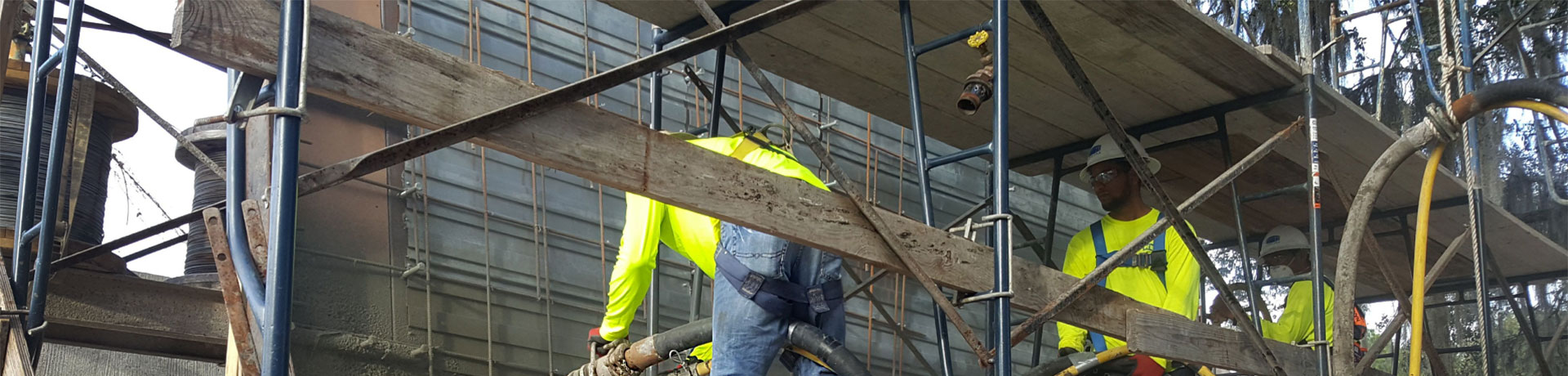
In recent years, shotcrete has been widely used for ground support in civil tunnels and mines in North America. Shotcrete technologies have advanced with robust robotic sprayers, high-performance shotcrete mixture designs, and high-performance fiber reinforcement in conjunction with rigorous qualification of shotcrete nozzlemen and QC inspection and testing programs. Design engineers and contractors are using shotcrete more and more often for various underground applications including ground support and final linings in tunnels in soft ground and hard rock mines, as well as in repair and rehabilitation projects in railway tunnels and other underground openings. Large underground caverns have been constructed using shotcrete as the initial liner in San Francisco and Los Angeles, and for both the initial liner and final liner in New York and Washington D.C. This article focuses on recent underground shotcrete technology developments from project experience and provides lessons learned. It also demonstrates that proper quality control and shotcrete qualification programs are critical for successful shotcrete projects.
On Productivity, Job Costing, and Successful Shotcreting
As a member of the International Honor Society in Economics and with a double BS in Finance and Banking, I came into the world of shotcrete prepared a little differently than most entrants to the field. That was over 20 years ago, but the principles of understanding Time, the Value of Money, and Opportunity Costs are indelibly ingrained into my psyche.
Shotcrete is often the best alternative when repair and restoration are being contemplated and can be the ideal application method for both reinforced and nonreinforced construction. From tanks and pools to chemical and automotive to retaining walls and highway structures, the opportunities are endless.
The shotcrete process has also been used for repair and installation of new linings in industrial melting and firing facilities since 1915. The relining of blast furnaces, ladles, and casting facilities, as well as petroleum and cement producing plants, are some of the applications that employ both wet and dry process shotcreting of specialty, heat-resistant materials. The shotcrete process allows for new installations during downtime and “hot” installation of certain materials as a routine part of the production cycle—another advantage of this unique concrete construction method.
Proper surface preparation allows the shotcrete professional to be able to integrate new materials with in-place construction to form a composite that will stand up to exposure and use. As important as the materials are the coordination of efforts from a properly qualified contractor, materials supplier, engineer, and architect. When all of these pieces are in place, the exceptional benefits of the shotcrete process are realized.
The ASA Technical Questions and Answers is a free service offered to all users, but primarily intended for engineers, architects, owners and anyone else who may be specifying the shotcrete process and/or has need for a possible answer to a technical question.
User agreement: The answers provided to submitted questions are intended for guidance in planning and executing shotcrete applications. This information is intended only for the use of individuals who are competent to evaluate the significance and limitations of its content and recommendations, and who will accept responsibility for the application of the material it contains. The American Shotcrete Association provides this information based on the best knowledge available to them and disclaims any and all responsibility for the information provided. The American Shotcrete Association will not be liable for any loss or damage arising therefrom.
If you are unable to find what you are looking for in the archive, then submit a new technical question.
ACI 318-14 (Building Code Requirements for Structural Concrete) requires post-installed expansion anchors to meet the testing criteria of ACI 355.2-07 (Qualification of Post-installed Mechanical Anchors in Concrete). ACI 355.2 specifies certain anchor testing and evaluation requirements to verify suitable anchor performance and to determine other aspects (such as failure mode) to use in conjunction with Chapter 17 of ACI 318 when designing the post-installed expansion anchors. Anchor testing is required largely to be performed by an independent agency and normally is conducted in normal weight and/or light weight concrete that meet pertinent ACI, ASTM and other requirements. Some post-installed expansion anchor manufacturers (like Hilti) have not had their anchors tested per ACI 355.2 in shotcrete type concrete, only tested in normal weight and light weight concrete. As such, these anchor manufacturers typically do not publish/offer any permitted load ratings, installation torques or other design and installation requirements for their expansion bolts when used in shotcrete. Instead, they recommend site testing to determine anchor performance or that the responsible design engineer can make an engineering judgment on anchor acceptability, as appropriate, if site testing is not performed. Do you have knowledge of any expansion bolt manufacturers that have tested their products is typical shotcrete? If yes to #1 above, do you know if the testing was done per ACI 355.2 requirements?
Shotcrete is a placement method for concrete. With proper equipment and placement techniques, concrete shotcreted in place will have strength, unit weight, permeability, and other hardened properties equivalent or superior to cast concrete consolidated by vibration. Due to delivering concrete material through relatively small diameter lines (1.5 to 2 in.) [38 to 51 mm] concrete mixtures for shotcrete placement typically limit the maximum coarse aggregate size to a nominal 3/8 to ½ in. (9.5 – 13 mm) size.
Thus, answering your specific questions:
- We are not aware of any expansion bolt manufacturers tests that used shotcrete placement of concrete for their test samples. However, tests on cast concrete should be equivalent with a given compressive strength and aggregate size/type in the concrete mixture.
- We expect that as answered in #1, that the tests run with ACI 355.2 requirements in cast concrete would have similar results when used with shotcrete placement of the concrete mixtures with similar hardened properties.
Also, note that ACI 318-19 directly includes shotcrete as a placement method for structural concrete.
We have a wet-mix shotcrete steel fiber overhead application progressing in our state. The question is about the use of a steel trowel finish, as opposed to say a magnesium or wood float finish. In the ASA Shotcrete Inspector seminar, it was stated that a steel trowel is less durable, reduces freeze-thaw resistance and shows cracking more proximately. As this particular application is overhead and, in a tunnel, there is not as much of a concern with water infiltration and the associated freeze-thaw exposure. We usually don’t allow steel trowels for flat work, due to deicing salts, but that concern wouldn’t apply here. My superintendent has asked me to reach out to you to see if you might have any further detailed advice on this type of application. Construction is wanting a smooth finish and looks do matter here as it is a high-profile project. If the DOT were to allow the steel trowel for finishing, what would be your concerns or suggestions to this approach?
Freeze-thaw deterioration is dependent on the concrete being saturated in multiple freezing/thawing cycles. In an overhead application, where water can’t stand on the surface, the concrete can’t be saturated unless water permeates through from the upper surface. And with good quality concrete in the tunnel, water shouldn’t permeate through, so it should be functionally watertight. As a result, freeze-thaw likely isn’t a critical durability issue.
A steel trowel finish does require extra working of the surface and would require the contractor to be very attentive to the proper time to obtain the finish yet not overly disturb the fresh concrete. Gravity is working against the overhead concrete staying in place.
Having a smooth steel trowel finish would make minor shrinkage cracks more noticeable. However, in the tunnel without exposure to sunlight or much wind exposure, and with proper attention to curing, perhaps surface cracking will be minimal.
We have an existing historic 4 in. (100 mm) hollow clay tile wall that is finished with a 3-coat gypsum plaster. We would like to spray shotcrete on the non-finished side of the wall to strengthen it. Will the application of shotcrete on the back side of the wall possibly damage the historic plaster and paint? Will there be too much of a vapor drive from the application for the plaster to hold? Have you experienced plaster deterioration or loose keys from the application of shotcrete on the backside of a wall?
As long as the hollow clay tile wall is rigid and stable, the shotcrete application should not impact the finished side plaster. Shotcrete impacts in a very localized area directly where the material stream is hitting the substrate. Research shows that the localized force is about 90 to 100 lbs (40 to 45 kg) when shooting directly on the substrate. If shooting a thicker wall using a benching method, most of the force is carried by the previously shot material, so it would have less impact. If the clay tile needs to be stiffened, an initial thin layer could be shot to provide additional thickness before the final thickness is placed. Though we don’t have any specific information about vapor transmittal, concrete used in shotcrete placement inherently has a low w/cm and less water in the mixture to bleed or create vapor. We haven’t had any reports of plaster or grout falling off the inside of masonry walls that have been structurally enhanced with shotcrete.
We have a client that has requested a shotcrete application for a dirt crawlspace. The facility is located in the Northeast part of New York. I’m not the designer, but I believe we are looking at a wet-mix, applied at a 4 in. (100 mm) depth throughout the crawlspace. I had a few questions I was hoping could get answered as we move through the technical specifications process. 1) Is there an off-season for the shotcrete product? Does it have to be applied in warm weather? Again, this is upstate NY. 2) What kind of equipment is used to dispense/place the product? (same as concrete?) 3) What is the noise level of the dispensing equipment? Typical of any concrete pour or much louder? The facility is a childcare center, so they are concerned about noise levels.
Here are the answers in the same order as your list.
- Shotcrete is just a placement method for concrete, so there is no “off-season.” However, as with cast concrete, cold weather placement needs more planning and material delivery controls. As wet-mix shotcrete material is predominately delivered by ready-mix trucks, the concrete should be delivered at 50°F (10°C) or higher. Then once shot, if temperatures are less than 50°F, the concrete should be protected by insulated blankets or the area enclosed by vented heaters to keep temperatures above 50°F. We also don’t want to shoot onto frozen surfaces.
- We use small line concrete pumps standard in the concrete industry.
- Concrete pumps and air compressors are generally diesel-powered engines. Pump engines range in horsepower from 75 to over 200 hp, depending on the pump size. Your application is of relatively low volume, so one of the smaller pumps should do fine. We also use relatively small air compressors, and many contractors who work in residential or metropolitan areas use equipment equipped with sound reduction. The sound at the point of placement where the air-accelerated material stream exits the nozzle is generally just the sound of the airflow.
10 Ave SE Bridge Rehab
BRIDGE HISTORY Listed on the National Register of Historic Places in 1989, the 10th Avenue Bridge in Minneapolis features seven reinforced
concrete arches to span the Mississippi River. The historic 1,141-ft (348 m) open spandrel column arch structure carries over 10,000 vehicles daily, as well as hundreds of pedestrians and cyclists between downtown Minneapolis and an area dominated by the University of Minnesota on the east bank.
UMA to Break NCDOT Record for Largest Square Footage of Soil Nail Wall
UMA is working as a geotechnical subcontractor to a Fluor-led joint venture (JV) with United Infrastructure Group, UMA to Break NCDOT Record for Largest Square Footage of Soil Nail Wall By Brian DeSpain, President, UMA Geotechnical Construction Inc. The project, formally known as NCDOT I-26 Exit 40 to I-40 Interstate Expansion Project, will help to alleviate traffic congestion and improve the safety and operational efficiency of this vital stretch of interstate in the Asheville area.