
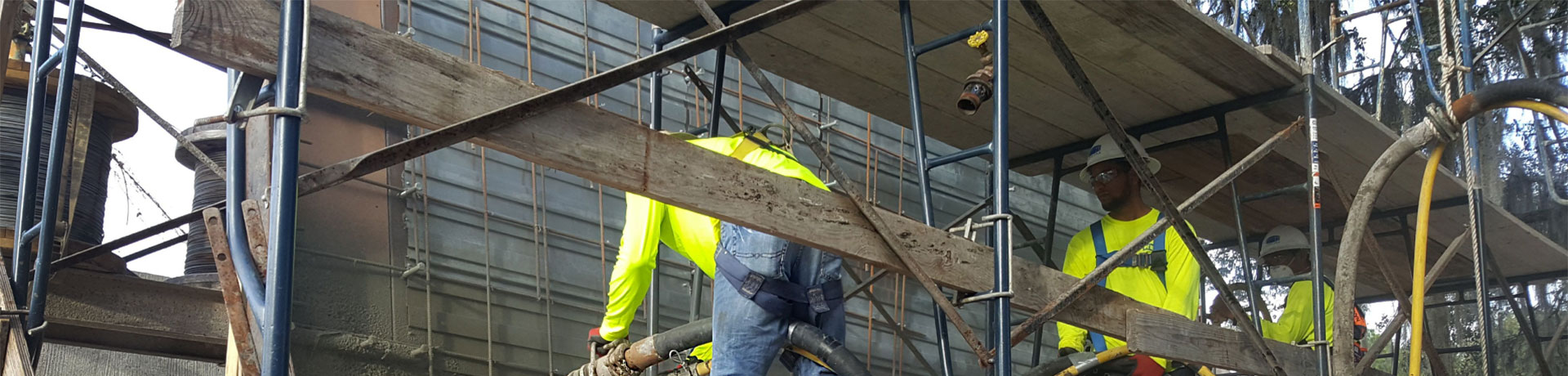
Shotcrete will adhere to properly prepared asphalt concrete. Shotcrete bond is generally related to the preparation of the surface that you want to bond with. If the surface is dirty, the shotcrete will not bond very well.
We are proposing a project that will use shotcrete on an existing metal bin wall to match recently constructed soil nail walls with shotcrete facing. What is the proper way to prepare the bin-wall surface? Also, what type of reinforcement would you recommend and what is the suggested method of attaching the reinforcement to the bin wall?
The surface should be cleaned using a high-pressure water blaster or sandblasting to remove any loose material and rust. If the metal bin material is thick enough, you might want to consider welding metal studs or nuts to the bin to secure the reinforcing steel or mesh. The amount and type of reinforcement is beyond the scope of our organization and we suggest getting guidance from a qualified engineer. You may gain some insight from the design of the reinforcing used in the soil nail walls.
Can a shotcrete mixture be designed using crushed washed sand instead of natural washed sand?
The grading of fine aggregates, natural or manufactured, should be in compliance with the combined aggregate gradations in ACI 506R or ASTM C1436. Using crushed washed sand will be more difficult than using natural washed sand due to the more angular particle shapes. Due to the more angular particles, crushed sand will likely require a higher paste content to successfully convey it through the shotcrete hose.
Type CA and FA shotcrete are two classifications listed in ASTM C1480. What is the application of these two types of shotcrete?
Type FA shotcrete uses a fine aggregate meeting the requirements of ASTM C1436 Gradation #1. Type CA shotcrete uses a combined aggregate gradation meeting the requirements of ASTM C1436 Gradation #2. The decision on which type to use depends on the application, shotcrete thickness, specification requirements, and perhaps the shotcrete equipment to be used, that is, wet- or dry-process. For example, one may want to use Type FA if using dry-process equipment and placing thin sections, or when a smooth finished surface texture is required. For thicker sections, Type CA shotcrete may provide the best properties for the application. The choice of which to use depends on the application, equipment, and experience of the contractor.
I have a question on cold weather shotcreting. I have heard that for shotcrete operations, the ambient temperature has to be 40°F (4.4°C) and rising. I am on a job, and the inspector said it only needs to be 35°F (1.67°C) and rising. The high for the day is expected to be around 45°F (7.2°C), then fall back into the high 20s F (–4 to –1.67°C). What would be your advice?
Shotcrete is concrete and the same rules apply with respect to cold weather applications. Cold weather is defined in ACI 306R, “Cold Weather Concreting” as “a period when, for more than 3 consecutive days, the following conditions exist: 1) the average daily air temperature is less than 40°F (4.4°C) and 2) the air temperature is not greater than 50°F (10°C) for more than one-half of any 24-hour period.” ACI 306R is an excellent reference that provides recommendations for cold weather concrete placement and protection. A copy of ACI 306R can be purchased online at ACI’s Web site, www.concrete.org, from the Bookstore and Publications tab. You can also download articles regarding cold weather placement from ASA’s Web site, shotcrete.org—click on “Shotcrete magazine,” go to the article search page, and type in “cold weather.”
Users should check the ASA on-line bookstore for the latest version to purchase. If not available in the ASA Bookstore, contact the authoring organization.
American Concrete Institute (ACI)
www.concrete.org
- ACI 506R, “Guide to Shotcrete”
- ACI 506.1R, “Guide to Fiber-Reinforced Shotcrete”
- ACI 506.2-13, “Specification for Shotcrete”
- ACI 506.4R, “Guide for the Evaluation of Shotcrete”
- ACI 506.5R, “Guide for Specifying Underground Shotcrete”
- ACI C-06, “Application and Use of Shotcrete,” 1981
- ACI CCS4, “Shotcrete for the Craftsman”
- ACI CP60, “Shotcrete Nozzleman Craftsman Workbook CP-60”
- ACI SP-14, “Shotcreting”, 1966, 224p.
American Association of State Highway and Transportation Officials (AASHTO)
www.bookstore.transportation.org
- AASHTO-AGC-ARTBA Joint Committee – Task Force 37 Report, “Guide Specifications for Shotcrete Repair of Highway Bridges,” (TF3&-1), 122pp.
- AASHTO-AGC-ARTBA Joint Committee – Task Force 37 Report, “Inspector’s Guide for Shotcrete Repair of Bridges,” December (IGSRB-1) 80 pp.
ASTM International (ASTM)
www.astm.org
- C42/C42M – Standard Test Method for Obtaining and Testing Drilled Cores and Sawed Beams of Concrete
- C1116/C1116M – Standard Specification for Fiber-Reinforced Concrete
- C1385/C1385M – Standard Practice for Sampling Materials for Shotcrete
- C1398 – Standard Test Method for The Laboratory Determination of the Time of Setting of Hydraulic-Cement Mortars Containing Additives for Shotcrete by the Use of Gilmore Needles
- C1140 – Standard Practice for Preparing and Testing Specimens from Shotcrete Test Panels
- C1141/C1141M – Standard Specification for Admixtures for Shotcrete
- C1436 – Standard Specification for Materials for Shotcrete
- C1480/C1480M – Standard Specification for Packaged, Pre-Blended, Dry, Combined Materials for Use in Wet or Dry Shotcrete Applications
- C1550 – Standard Test Method for Flexural Toughness of Fiber-Reinforced Concrete (Using Centrally Loaded Round Panel)
- C1604/C1604M – Standard Test Method for Obtaining and Testing Drilled Cores of Shotcrete
- C1609/C1609M – Standard Test Method for Flexural Performance of Fiber-Reinforced Concrete (Using Beam With Third-Point Loading)
- STP- 169D – “Significance of Tests and Properties of Concrete and Concrete-Making Materials,” 2006, J. Lamond and J. Pielert Editors – Chapter 53 – “Shotcrete”, John H. Pye, pp 616 – 624.
International Tunneling Association (ITA)
www.ita-aites.org
- Working Group 12 – Shotcrete Use – Publications:
- Report: Shotcrete in Tunneling: Status Report 1991.
- Report: Shotcrete for Rock Support – Guidelines and Recommendations – A compilation 1992.
- Shotcrete for Underground Support: State-of-the-Art Report with Focus on Steel-fibre Reinforcement,1992, 8 pp.
- Shotcrete for Rock Support: A Summary Report on the State-of-the-Art in 15 Countries, 1993, 29 pp.
- Health and Safety in Shotcreting, 1996, 18 pp.
- Sprayed concrete for final linings: ITA Working Group Report, 2001, 14 pp.
- Lining of Tunnels under Groundwater Pressure, 2002, 6 pp.
- Shotcrete and Waterproofing for operational tunnels, 2005.
- Shotcrete for rock support: a summary report on the state of the art
American Society of Civil Engineers (ASCE)
www.asce.org
- Conference Proceedings
Note: Some Proceedings are out of print, however individual papers may be available. - Use of Shotcrete for Underground Structural Support, Engineering Foundation Conference, South Berwick, ME, Jul 16-20,1974, 467 pp. (Also see ACI SP-45) Shotcrete for Ground Support, Engineering Foundation Conference, Easton, MD, Oct 4-8, 1976, 763 pp. (see ACI SP-54)
- Shotcrete for Underground Support V, Engineering Foundation Conference, Uppsala, Sweden, Jun 3-7, 1990, J. Sharp and T. Franzen Editors, 560 pp.
- Shotcrete for Underground Support VI, Engineering Foundation Conference, Niagara-on-the-Lake, ON, May 2-6, 1993, D. Wood and D. Morgan Editors, 198 pp.
- Shotcrete for Underground Support VII, Engineering Foundation Conference, Telfs, Austria, Jun 11-15, 1995, H. Kdapperich, R. Pöttler and J. Willocq Editors, 313 pp.
- Shotcrete for Underground Support VIII, United Engineering Foundation Conference, São Paulo, Brazil, Apr 11-15, 1999, T. Celestino and H. Parker Editors, 349 pp.
- Shotcrete for Underground Support X, Engineering Conferences International Conference, Whistler, Canada, Sep 12-16, 2006, D. Morgan and H. Parker Editors, 382 pp.
- Shotcrete for Underground Support XI, June 7-10, 2009 – Davos, Switzerland, Editors:Felix Amberg, M.o.S. ETHZ, SIA, Switzerland, Knut F Garshol, BASF Construction Chemicals, LLF, USA
- Shotcrete for Underground Support XII, October, 2015, Singapore. Professor Ming Lu, Nanyang Technological University Dr. Oskar Sigl, Geoconsult Asia Singapor PTE Ltd, Dr. Guojun Li, Singapore Metro Consulting Eds.
- Shotcrete for Underground Support XIII, September 3-6, 2017. Kloster Irsee (near Augsburg), Irsee, Germany (Conference Proceedings will be available later), Professor Dr.-Ing. Dietmar Mähner, Institute for Underground Construction, FH Münster, Germany
Norwegian Concrete Association (NB)
www.betong.net
- “Sprayed Concrete: Modern use of wet mix sprayed concrete for underground support,” Proceedings, International Symposium on Sprayed Concrete, Fagernes, Norway, Oct 1993, R. Kompen, O Opsahl and K Berg Editors, 464 pp.
- “Sprayed Concrete: Modern use of wet mix sprayed concrete for underground support,” Proceedings, Second International Symposium on Sprayed Concrete, Gol, Norway, Sep 23-26, 1996, 433 pp.
- “Sprayed Concrete: Modern use of wet mix sprayed concrete for underground support,” Proceedings, Third International Symposium on Sprayed Concrete, Gol, Norway, Sep 26-29, 1999, 525 pp.
- “Sprayed Concrete: Modern use of wet mix sprayed concrete for underground support, Proceedings, Fourth International Symposium on Sprayed Concrete, Davos, Switzerland, Sep 22-26, 2002, 365 pp.
- “Sprayed Concrete: Modern use of wet mix sprayed concrete for underground support, Proceedings, Fifth International Symposium on Sprayed Concrete, Lillehammer, Norway, Apr 21-24, 2008, 346 pp.
- “Sprayed Concrete: Modern use of wet mix sprayed concrete for underground support, Proceedings, 7th International Symposium on Sprayed Concrete, Sandefjord, Norway, June 16-19, 2014, 458 pp.
- “Sprayed Concrete: Modern use of wet mix sprayed concrete for underground support, Proceedings, 6th International Symposium on Sprayed Concrete, Tromsø, Norway, September 12-15, 2014, 426 pp
Other Volumes
- “Shotcrete: A Compilation of Papers by Dudley R. ‘Rusty’ Morgan,” American Shotcrete Association, Farmington Hills, MI, 2008, 424 pp. shotcrete.org
- “Tunneling is an Art,” Marc Vandewalle, N.V. Bekaert, S.A., Zwevegem, Belgium, 2005, 400 pp.
- “Recommended Practice – Shotcreting in Australia,” Concrete Institute of Australia / Australian Shotcrete Society, May 2008, 67 pp.
- “Shotcrete: Engineering Developments,” Proceedings, International Conference on Engineering Developments in Shotcrete, Hobart, Tasmania, Australia, Apr 2-4, 2001, E. Stefan Bernard Editor, 268 pp.
- “Shotcrete: More Engineering Developments,” Proceedings, Second International Conference on Engineering Developments in Shotcrete, Cairns, Queensland, Australia, Oct 4, 2004, E. Stefan Bernard Editor, 291 pp.
What can we add to dry-process shotcrete mixtures for cold weather operations?
Successful cold weather placements require more than just modifying a mixture. The mixture temperature, condition of the substrate, and the placing and curing environment are also important considerations. Generally, one is discouraged from trying to apply shotcrete if substrate temperatures are too cold and the ambient temperature is at 40 °F (5 °C) and falling. There are, however, exceptions for extreme situations such as shotcreting in permafrost ground conditions, where it is not possible (or advisable) to heat up the substrate. In such conditions, special accelerated dry-mix shotcretes (in conjunction with the use of heated materials) have been successfully used. This type of work is highly specialized and not recommended for the novice.
Accelerators can be added to shotcrete mixtures to help overcome cold weather conditions. The accelerator can be either a liquid accelerator added with the mixing water at the nozzle or a dry-powdered accelerator in prebagged dry-mix shotcrete. Caution is advised when using accelerators containing calcium chloride, as the use of these materials may accelerate corrosion of reinforcing steel. More information can be found in ACI 306R, “Cold Weather Concreting,” available from the American Concrete Institute, www.concrete.org.
I am a project engineer. Recently I received a mixture design for a shotcrete project that included limestone coarse aggregate. This is a first for me. All other shotcrete mixtures I have seen have had pea gravel as a coarse aggregate or no coarse aggregate at all. Is limestone commonly used in shotcrete?
A limestone coarse aggregate will generally be harder and more angular than what you are used to seeing in shotcrete mixtures. It really shouldn’t be a problem to use. In dry-process gunning, it is considerably more abrasive so there is more wear and tear on equipment, such as hoses, bowls, and wear plates, but it generally guns fine. In wet-process gunning, a sharper aggregate may not flow as easily through the hoses as smoother sand and pea gravel aggregates would. These are issues that the shotcrete contractor will have to address. They should have no effect on the quality of the in-place shotcrete.
Is there any specified finish for shotcrete?
There are several different finishes that are specified for shotcrete. One is a natural gun finish, which is the natural finish as sprayed (often used in slope protection). Another is a cut-down finish, which is cut-to-grade with the edge of a trowel or cutting rod (this finish is often flashed and sealed with a light gun finish to seal and texture the surface). Often in concrete repair, a trowel finish is specified where the shotcrete is cut down with the edge of a trowel or cutting rod to grade after the initial set of the material, and the surface is lightly flashed and toweled. Several different finishes can be achieved with shotcrete, but it should not be pushed or floated with the flat part of the trowel, as is done with poured concrete. It is important to wait for the initial set of the material and to use the edge of the trowel to cut the high points or shave the surface to achieve the grade or effect desired. Several excellent articles describing shotcrete finishes and finishing techniques are available as free downloads from the ASA website: shotcrete.org. One article, Technical Tip: Technical Tips on Shotcrete Finishes, written by Denis Beaupre, describes the different finishes that can be applied to shotcrete. Another article of interest would be Finishes for Retaining Walls by Marcus H. von der Hofen. Go the Publications section of the ASA website, click on “Click here to search the archive of Shotcrete Publications” and type “Shotcrete Finish” in the search window.