
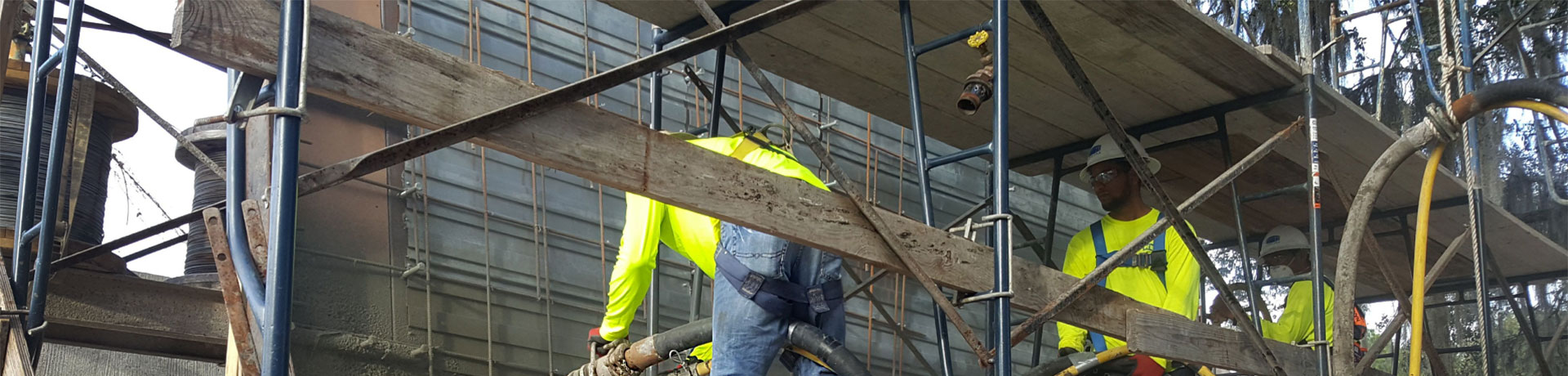
March 2002, and May 2002. Work was conducted inside process vessels in a pulp mill by the specialized lining contractor, Canadians Stebbins Engineering Ltd., and the shotcrete contractor, Béton Projeté M.A.H. Due to operational constraints and significant costs involved with downtime, the contractors™ primary goal was to perform a repair that would provide long-term reliability within the shortest construction period possible.
Grain Silo Rupture Repair
Barlett & Co. faced a huge cleanup job at its 6.9 million-bushel trail terminal in Wichita, Kanasas in the fall of 1999. A grain silo in diameter and tall holding roughly 150,000 bushels.
Designing and Installing a Shotcrete Strengthening Application on the Spokane Street Bridge
The Spokane Steet Bridge connects the community of West Seattle to downtown via Highway 99 and Interstate south of the city center. The bridge was not originally and constructed to handle is present-day usage consequently.
Use of Synthetic Fiber-Reinforced Dry-Mix Shotcrete for the Rehabilitation of a Wharf in Northeast Quebec, Canada
Use of Dry-Mix Shotcrete to Repair a Lighthouse Structure
This paper presents a description of the repair work carried out in 1996 at the Haut-Fond Prince lighthouse structure located in the St. Lawrence River, 8 km (5 mi) from the coast of Tadoussac, Quebec, Canada. The damaged section of the structure in the tidal zone was repaired using dry-mix shotcrete. Due to the particular field conditions (freezing-and-thawing cycles, ice erosion and im-pact, submersion of the repair zones only minutes after the application of shotcrete, etc.), the mixture used contained high early strength cement, silica fume, steel fibers, a liquid air-entraining admixture, and a powdered set-accelerator admixture. Removal of deteriorated concrete, preparation of the surface, replacement of the reinforcement, specifications for the shotcrete produced, as well as the application procedures are described in this article. A certifica-tion session was held to verify the skills of the nozzlemen. Only those qualified were authorized to apply shotcrete on the structure.
This article describes the repair work carried out at the Haut-Fond Prince structure located in the St. Lawrence River at the confluence of the Saguenay and the St. Lawrence rivers, 8 km (5 mi) from the coast of Tadoussac, Quebec, Canada (Fig. 1).
New Mixture Design and Guide Specifications and Inspector’s Manual
Shotcrete has not traditionally been a material of choice for repair of bridge structures by many state highway departments. One reason for this is that bridge engineers have not been aware of advances in the quality and durability possible with high-performance shotcrete over the last 10 to 15 years. In 1995, an effort was made to help facilitate and encourage the use of shotcrete in bridge repair, especially where it is particularly advantageous: in overhead and vertical surfaces and in thin layers, or a combination of thin and highly reinforced thick layers. The effort was organized by the AASHTO-AGC-ARTBA Joint Committee.
Shotcrete with Steel Fiber Helps Reinforce Mount St. Helens Project Savings
Thirteen-hundred feet (400 m) of the peak collapsed or blew outwards. As a result, 24 square miles of the valley was filled by a debris avalanche of recreation.
Evolution of Fiber Reinforced Shotcrete
The concept of reinforcing shotcrete with discrete, disominous steel fibers was developed by the Battelle Research Corporation in the USA in the early 1970s.
Shotcrete Rehabilitation of a Vancouver, BC Historic
A heritage high-rise building in Vancouver, Canada required rehabilitation due to corroÂsion of the steel frame and cracking in the masonry infill. Brick masonry was segmentally removed from the face of this 15-story-high building to expose the steel beam and column framjng system. Steel corrosion products were removed by needle scaling and sandblasting. New steel plate was welded to the beams and columns where required to strengthen the structure to its original design. Rebar was installed in the previously brick-filled cover to the steel frame and a high quality, low permeability silica fume shotcrete was applied to encase the rebar and fill the void. The south side of the building was
Seismic Reinforcing of Masonry Walls With Shotcrete
Photos and newsclips showÂing hundreds of collapsed homes buryÂing entire families have become all too commonplace. As residents of North America we are thankful that this sort of calamity doesn’t happen here. The earthÂquakes we’re used to seeing (mainly in California) cause inconvenience and in some cases property damage, injury and even some deaths, but nothing as cataÂstrophic as in Turkey this year and Azerbaydzhan a few years back.