
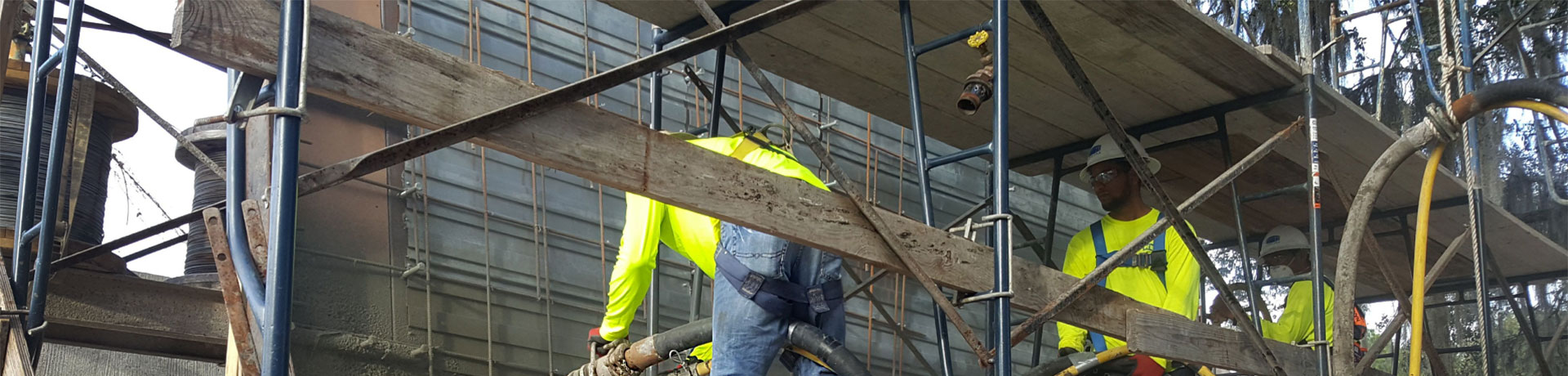
The widespread use of structural shotcrete actually began long before the ï¬rst appli-cation was made. Its rise was politically motivated and its continued development dictated by the occurrence of earthquakes. Responding to a school ï¬re in the 1920s, the Los Angeles School Board directed that all future school buildings be constructed of masonry. However, masonry of the day was not reinforced, and several hundreds of these buildings were destroyed or damaged in the great Long Beach earthquake of 1933. Fortunately, the quake occurred in the early morning hours when the schools were unoccupied; had it been during the day, hundreds of deaths and thousands of injuries would have likely resulted.
Surface Preparation for Shotcrete Repairs
Surface preparation is an important element of the repair process, both with shotcrete and cast-in-place concrete. It covers a large scope, including concrete removal, saturation of the substrate, the use of bonding agents (rare with shotcrete), and cleaning of the surface. These operations are influenced by the local conditions (surface position: vertical or overhead, the presence of reinforcement) and are very important for both the short- and long-term bond strength and, thus, the repair integrity. When all steps involved in surface preparation are considered, it is obvious that these operations represent a large part of the repair cost and may reach up to 50% of the total repair cost. For this reason, it is important not to neglect surface preparation.
Washington State’s Capitol Seismic Repair
Washington State’s Capitol Seismic Upgrade will surely rank as one of the top restoration projects of this decade and shotcrete proved to be essential to its success. As with most complex rehabilitations, many of the hurdles faced arose after the project had begun. The ability of the contractors, engineers, and architects working together to overcome these issues proved once again to be the crucial factor in the success of the project.
Thick Section overhead Repair and Strengthening of a Concrete Pier: A Viable Shotcrete Solution
When considering placement options for thick section overhead concrete repair or strengthening, more often than not, the consideration of a shotcrete solution is overlooked. Historically, shotcrete has suffered from being mainly associated with vertical placements for above ground work. This may be due to the fact that until 1983, silica fume enhanced shotcrete was unheard of in North America; therefore, building up placement lifts overhead of more than a few inches thick using shotcrete was not deemed possible. Additionally, many shotcrete contractors customarily have avoided low production applications where placement volumes are measured in cubic yards per day rather than cubic yards per hour. As a result, most thick overhead concrete sections have been placed via the more common method of forming and pumping.
In general, forming and pumping concrete overhead works adequately. In deep sections the concrete or repair material is pumped through a port or valve on the bottom or lower side of the stout form. In effect, the air inside the form is pushed up and ultimately out of the concrete placement location. In deep section repair, there can be challenges devising a methodology that ensures no air is trapped in the upper sections of prepared areas. Repairs to pile caps may preclude the coring of vent holes down through the top of the deck due to congestion of reinforcing steel. In a form and pump application, the issue of adequate bond to the prepared concrete substrate is also a consideration. Most repair installations require a composite action of new material to existing concrete. Curing, shrinkage, and the presence of bleed water floating on top of the new concrete placement may adversely affect the ultimate bond strength of these installations. The aspect of building forms for repair and strengthening placements, especially around precast piling, can be difï¬cult and extremely time consuming as well.
Careful consideration of the pros and cons of shotcrete placement over a more traditional approach of forming and pumping for thick overhead sections offers compelling technical evidence for pursuing a shotcrete option. The following case
Shotcrete Foundation Walls at the Smithsonian Portrait Gallery in Washington, DC
The National Portrait Gallery, located on the campus of the Smithsonian Institution in Washington DC, is one of the oldest government buildings in that historic city. It was the original location for the U.S. Patent Office and it was used as the site of the inaugural ball celebrating the election of Abraham Lincoln in January 1861. When a recent renovation and expansion project was started on the building, shotcrete was selected as the material of choice
Waterproofing and Concrete Restoration at Blackwater Dam
One of the oldest dams in New England, the Blackwater Dam in Webster, NH, is located approximately 8.6 mi above the confluence of the Blackwater and Contoocook Rivers. It is part of a network of ï¬ve flood-control dams in the Merrimack River Basin that work together to control flood waters during heavy rains and storms until rivers begin to drop and the stored water can be slowly and safely released. The reservoir has a storage capacity of 15 billion gal. of water.
The U.S. Army Corps of Engineers (USACE), who oversees the property, engaged The Aulson Company to complete major concrete repairs and waterprooï¬ng to restore the dam and pedestrian walkway to peak condition after 60 years of deterioration. The USACE had made previous attempts at restoration but was not satisï¬ed with the results.
The Restoration Challenge
When the Blackwater Dam was built in 1941, the technology used to mitigate expansion and contraction was to install horizontal and vertical joints. No weepholes were provided in the original design to allow drainage back to the channel, so
Concrete Repair and Restoration at Franklin Falls Dam
The Aulson Company of Methuen, MA, completed a major concrete removal, shotcrete repair, and restoration project for the U.S. Army Corps of Engineers (USACE) at the Franklin Falls Dam, a 60-year-old structure in Franklin, NH. The Franklin Falls Dam was built by the USACE as part of a coordinated system of reservoirs to provide flood control on the Pemigewasset River Watershed of the Merrimack River Basin in the state of New Hampshire. Authorized by the Flood Control Act of 1936, the project is located on the Pemigewasset River, the main tributary of the Merrimack River, approximately 2.5 mi upstream from the city of Franklin, NH. Construction of the project began in November 1939 and was completed in October 1943. The reservoir is operated for flood control and has a total storage capacity of 154,000 acre-ft. The dam is constructed of rolled earth ï¬ll, with protective rip rap, rising 140 ft above the river bed. The spillway consists of an excavated channel along the westerly
Shotcrete Repair of WWII Concrete Hulks
In response to a shortage of plate steel during the Second World War, the United States Maritime Commission ordered 24 ships and 58 barges to be constructed with lightweight concrete. The ships were typically about 336 ft (110 m) long with a beam of 54 ft (16.5 m) and a displacement of about 11,000 tons (10,000 t). These ships and barges performed various levels of military service but typically for relatively short times due to several factors, not the least of which was the end to hostilities shortly after their launches. The useful service of these vessels (as ships and barges) was measured in months, with some being decommissioned immediately after delivery. However, at Powell River in British Columbia, Canada, as a floating breakwater and impoundment for the log storage pond, most of the surviving hulks have over 50 years of service in a saltwater environment. The Powell River floating breakwater is comprised of seven WWII steam-ships, two WWII barges, and one WWI steamship. The paper mill in Powell River acquired these ships between 1948 and 1966. After their arrival, the ships were stripped of amenities and machinery and the hulks placed in service as a breakwater.
For most of the hulks™ life as a breakwater, they were protected from direct barge impact by the numerous logs floating in the storage pond deï¬ned by the hulks. With the changing operations of the mill and the removal of the logs, the hulks became vulnerable to impact by barges also operating in the pond. This article describes the recent shotcrete repair of the impact damage to some of the hulks.
Need for Repair
While the hulks are showing deterioration related to the corrosion of the reinforcing steel due
The Setenave Dry Docks Rehabilitation
Sentenave is ageneral designation for a shipyard built in the ninty seventies at the right end of Portugal
Silica Fume in Shotcrete
Silica fume is a highly pozzolanic mineral admixture that has been used mainly to improve concrete durability and strength and as portland cement replacement. Silica fume has been used primarily in the United States, Canada, and the Scandinavian countries, but is now finding increasing use elsewhere in the world.