
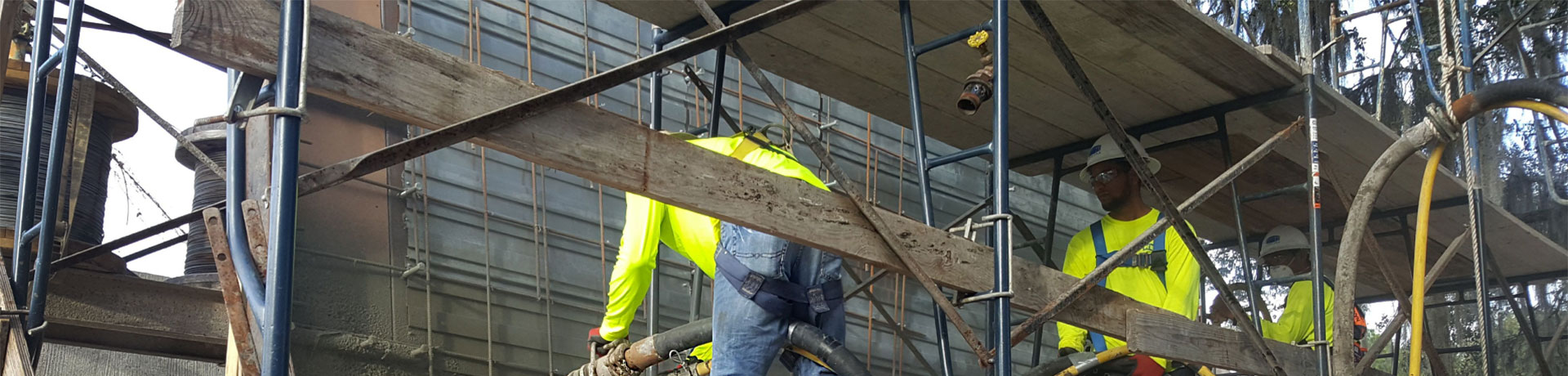
The small village of Sissach, near Basel, in Switzerland is one of the nicest Swiss villages in the country, but the serenity is plagued each rush hour by heavy commuter traffic. The solution was a bypass tunnel running through the Chienberg hill to the north side of the village. Shallow cover, unconsolidated material at the portals, a TBM pilot tunnel, and the potential for squeezing ground conditions distinguish the Sissach tunnel from many tunnels currently under construction in Switzerland.
The 2284 m (7500 ft) long Sissach bypass tunnel runs a maximum of 120 m (395 ft) beneath the Chienberg hill and beneath the picturesque homes of the Sissach village. It was originally intended to run the two-lane bidirectional bypass up and over the hill on the surface, but protests by the local villages forced the local Canton government to adopt an underground route for the heavy commuter traffic currently passing through the village.
To accommodate the shallow underground route, the alignment is divided into three separate sections: a section of 550 m (1800 ft) cut-and-cover and 200 m (656 ft) cover and cut on the west end, followed by a 1440 m (4725 ft) length of mined tunnel, and a 94 m (308 ft) section of cut-and-cover at the east end.
The first 550 m (1800 ft) of cut-and-cover on the west end of the project was completed under a separate contract and included the boxed section over the Ergolz River. The contract for the main bypass civil works, including the mined tunnel, was awarded to the Arge Chienbergtunnel Sissach, a joint venture led by the Batigroup, Switzerland™s
Shotcrete for Underground Support IX
The Japan Tunnelling Association (JTA) and International Tunnelling Association (ITA) sponsored the Shotcrete for Underground Support IX Conference held in Kyoto, Japan, from November 17-20, 2002. It is a cooperative conference with the United Engineering Foundation, New York, which sponsored the previous eight conferences, the first of which was held 30 years ago. A total of 35 papers were presented at the conference, 34 of which are published in a proceedings available from the JTA. The conference was chaired by Koichi Ono, Professor, Kyoto University, Japan, and co-chaired by D. R. (Rusty) Morgan, Chief Materials Engineer, AMEC Earth & Environmental Limited, Vancouver, British Columbia, Canada.
The conference was a resounding success. It was attended by over 70 delegates, with papers from Japan, South Korea, Vietnam, India, Canada, Brazil, France, Finland, Norway, and Switzerland. Keynote addresses were given by Koichi Ono from Japan on œShotcrete Use in Tunnelling Works in Japan (over 2 million m3 per annum); Minema Ikoma from the Japan Railway Construction
Silica Fume in Shotcrete
Silica fume is a highly pozzolanic mineral admixture that has been used mainly to improve concrete durability and strength and as portland cement replacement. Silica fume has been used primarily in the United States, Canada, and the Scandinavian countries, but is now finding increasing use elsewhere in the world.
Development of a Centrifugal Sprayed System for Shotcrete Application
A new Japanese Ministry of Health document provides regulations and guidelines for the allowable dust concentration in tunnel works. The recommended maximum concen-tration should be less than 3.0 mg/m3 (2.3 mg/y3) at 50 m (164 ft) from the tunnel face. To observe this guideline, it is a serious problem as to how to reduce the generation of mineral particles of dust during shotcreting operations. In general, shotcrete is placed using pneumatic energy. This is a main factor causing dust generation during shotcrete operations. It may be easily imagined that if shotcrete application can be conducted by centrifugal force, dust concentration would be dramatically reduced. In this paper, we describe the development of a centrifugally sprayed shotcrete system named Dustless Shotcrete and also provide the results of a practical application of this technology at the Hishino Tunnel.
Steep Slope Stabilization with Fiber-Reinforced Shotcrete
For the past 150 years or so, roads have been built through the mountain passes in the western U.S. and Canada. Sometimes these roads led to mines; sometimes they started as logging roads. Some were built for access roads for the railroad. Many were built so that people could drive wagons, stagecoaches, and later, automobiles to their destinations. As time went on, some of these roads were abandoned, while others were turned into highways and scenic byways. These roads can be seen on maps, criss-crossing through mountain passes, valleys, and wherever passage was possible. Many of these roads were constructed along mountain slopes, carved out using the largest equipment available at the time, sometimes by hand work, and sometimes by blasting through rocky areas. Road conditions in some of these areas can change dramatically throughout the year. In the mountains, vast amounts of snow can accumulate during the course of just a few days. Sometimes there are heavy rain storms. There can be snow avalanches and mudslides from the rain and snow. In times of drought, vegetation might dry out and die, leaving slopes exposed to erosion, increasing the probability of avalanches and mudslides. Because of varying climactic conditions, freezing-and-thawing cycles, radical changes in the amount and nature of moisture, steepness of slopes, and other factors, slopes need to be stabilized so that rocks, trees, debris, and other factors not listed do not unearth them-selves and become hazards to all things below them. One of many ways to secure and stabilize highway slopes is by the use of ï¬ber-reinforced shotcrete (FRS), usually along with either rock bolts or some other mechanical device drilled into the rock or slope. This paper provides an overview of why ï¬ber-reinforced shotcrete is an excellent choice in lieu of plain shotcrete reinforced with either welded wire mesh or rebar mats for such slope stabilization work.
Specification of Shotcrete Toughness
Fiber-reinforced shotcrete has become an established material for ground support in tunnelling and mining applications as well as in new construction and infrastructure repair. Designers and speciï¬ers frequently require such shotcrete to maintain some quantiï¬able postcrack strength or toughness. Until the newly published round panel test method (ASTM C 1550-03)1 becomes more widely used, North American designers and speciï¬ers will likely continue to refer to toughness parameters as determined by the beam test method (ASTM C 1018).2 The following sections discuss various toughness parameters associated with this beam test and their signiï¬cance.
Innovative Shotcrete Application Over Geofoam Structure Supporting Boston’s Central Artery Tunnel
The objective of Boston’s Central Artery/Tunnel (CA/T) Project is to ease the congestion of approximately 190,000 vehicles per day traveling through the city of Boston. This objective is being achieved through the total reconstruction of Interstate Highway I-93 as it passes through the heart of Boston, together with the extension of Interstate I-90 from its terminus at I-93 just south of downtown Boston to Logan International Airport in East Boston. The Artery replaces an elevated six-lane highway that opened in the late 1950s and originally carried approximately 75,000 vehicles per day. The focus of this article is on two transition structures and ramps in the C09C2 Construction Contract: the I-93/I-90 Interchange Ramps and Surface Restoration at Albany Street, where shot-crete facing has been implemented as a facing system for lightweight embankments.
Steel Fibrous Shotcrete: A Summary of the State-of-the-Art
Steel fibrous shotcrete has been used for mine and tunnel linings, for rock slope stabilization, in dam construction, for repair deteriorated surfaces and arches, for fire protection coatings and in thin-shell dome construction.
Release of New ASTM Round Panel Test
Following a 3-year development period, a new test for post-crack performance assessment of ï¬ber-reinforced shotcrete (FRS) and ï¬ber-reinforced concrete (FRC) based on round panels was passed by ASTM Committee C 09 in June 2002. The standard test method, known as C 1550-02, œStandard Test Method for Flexural Toughness of Fiber-Reinforced Concrete (Using Centrally-Loaded Round Panel), was published in the 2002 edition of the Annual Book of ASTM Standards V. 4.02.1 Publication of this standard test method is a major development in the fiber-reinforced shotcrete industry. It will, for the ï¬rst time, permit a both reliable and economical estimation of post-cracking performance for this material.
The use of ï¬bers in shotcrete has become an established form of reinforcement in many sectors of the underground construction industry over the last 20 years. The effective measurement of post-crack performance (toughness) in this material, however, is a problem that has plagued the industry and made the influence of parameters such as ï¬ber type, mixture design, and spraying technique difï¬cult to determine. Much of the difï¬culty is attributable to the high levels of within-batch variability obtained for even well-prepared sets of FRS samples when beams are used as the basis of toughness assessment. Typical levels of within-batch variability for toughness indices obtained using ASTM C 1018 beams range from 13 to 18%.2,3 More than18% is common for residual strength obtained using EFNARC beams.4 The imprecision associated with such high levels of variability has obscured trends in performance development and eroded conï¬dence in the material. Some improvement occurred with the introduction of EFNARC panels in the 1990s,5,6 but this test suffered its own difï¬culties associated with seating problems and high costs. Other types of specimens have seen occasional use,7-10 but the size and expense of these tests have limited their use to special applications.
The ï¬rst round panel test similar to the C 1550 conï¬guration was undertaken in 1997 as part of an investigation of the influence of support conditions on structural behavior in FRC panels.11 The potential of this test was recognized by the Roads and Traffic Authority of New South Wales in Australia, which immediately sponsored a comparative study of FRS performance for several commonly available ï¬bers.12 A speciï¬-cation based on this test13 was also introduced
Shotcreting in Australian Underground Mines: A Decade of Rapid Improvement
Over the last decade, dramatic improvements in spraying technology have allowed shot-crete to become the first-choice ground support in many underground mines in Australia. Before 1994, only a very small amount of dry spray shotcrete was used. Since then, the increased use of wet-mix ï¬ber-reinforced shotcrete has been extremely rapid, spurred along by improvements in machinery, admixtures, fibers, and under-standing the way shotcrete behaves as a ground support element.
Today, nearly 100,000 m3 (130,000 yd3) of shotcrete is applied annually in some 20 under-ground mines. While volumes have leveled off during a recent period of depressed metal prices, it is almost certain to boom again as metal prices improve and new mines come online. Australian mines are characterized by reasonably shallow ore bodies hosted in hard rock. This made under-ground mining initially fairly simple with little ground support needed beyond a few rock bolts. As surface deposits have become depleted, however, mine owners are increasingly spending their exploration dollars drilling beneath existing deposits to ï¬nd new resources. This has led to ever-deepening extraction depths and associated ground support difï¬culties.