
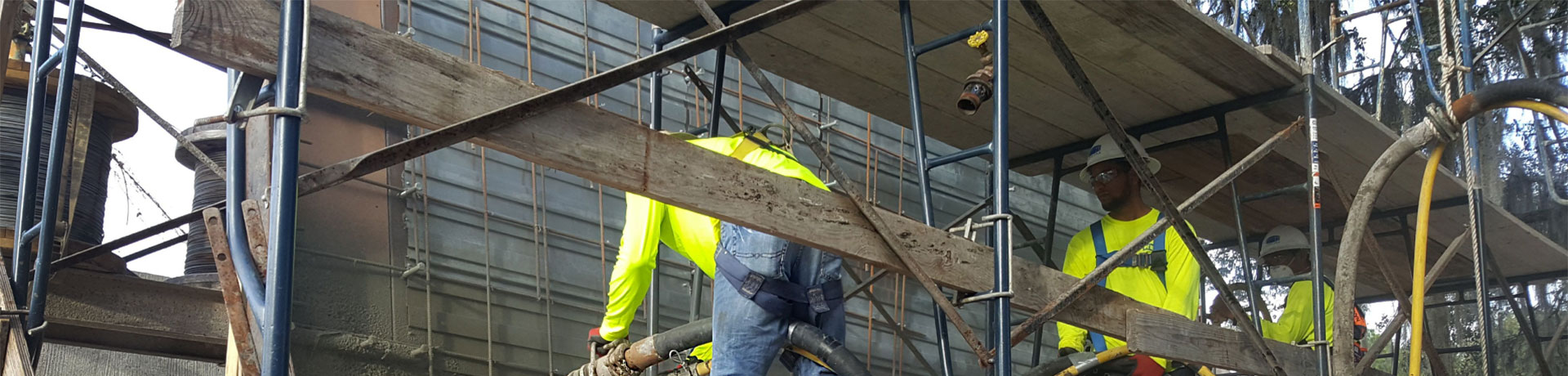
I am a TBM Tunnel Engineer from India, and I was looking for information on the applicable compressed air pressure range required for a wet-mix shotcrete application (small shotcrete pump-capacity 7 CU.M/Hr) hand spraying with a 30m hose for a better-compacted mix. I would kindly request you to please send me information on the pressure range to be expected for good quality shotcrete placement of the concrete mix on the rock substrate in NATM Tunneling.

Wet-mix shotcrete depends on air flow at the nozzle to accelerate the concrete to 60 to 80 mph (100 kph to 130 kph). Most air compressors produce their air flow capacity at 100 to 120 psi (7 to 8.4 kg/cm2) at the compressor. However, depending on the size length and couplings in the air hose, there may significant pressure drops when the air reaches the nozzle. Here’s what ACI 506R-16 Guide to Shotcrete Section 4.4.2 states for wet-mix:

“The recommended ft3/min (m3/min) needed for the wet-mix process is between 200 to 400 ft3/min (5.7 to 11.3 m3/min) air volume at 100 psi (7 bar). Higher air volume capacities are needed for higher volume and higher-velocity shotcrete applications. If a blowpipe is to be used during the shooting process, more air will be required to run both operations simultaneously. Conducting a test during the preconstruction testing phase using a blowpipe while gunning the wet-mix material will indicate if the air compressor has enough air volume capacity to perform both tasks at the same time. Long, small-diameter lines may not provide sufficient air volume capacity, even with a large air compressor. Test and consider increasing the size of the air line.”

Though there is no direct guidance for air pressure at the wet-mix nozzle you may consider the guidance for dry-mix air pressure in ACI 506R Section 4.4.1:

“The operating air volume (ft3/min [m3/min]) drives the material from the gun into the hose, and the air pressure is measured at the material outlet or air inlet on the gun. The operating pressure varies directly with the hose length, the density of the material mixture, the height of the nozzle above the gun, and the number of hose bends. Experience has shown that operating pressures should not be less than 60 psi (4 bar) when 100 ft (30 m) or less of material hose is used, and the pressure should be increased 5 psi (0.34 bar) for each additional 50 ft (15 m) of hose and 5 psi (0.34 bar) for each additional 25 ft (7.5 m) the nozzle is above the gun.”

The minimum 60 psi (4 bar) necessary for dry-mix could be applied to the wet-mix air supply as the velocity created by the air flow is similar.

I would like to know the fire rating information on a shotcrete wall, 8 in. thick.

Shotcrete is simply a placement method for concrete. Thus, fire resistance of any shotcreted concrete section can be evaluated by consulting ACI CODE-216.1- 14(19) Code Requirements for Determining Fire Resistance of Concrete and Masonry Construction Assemblies. There are many factors that affect the fire resistance so you will need to review the code to establish what’s appropriate for your structure.

Is there a guide to determining pressure applied to a form during shotcrete placement? I have seen references to 50 lb/ft2 (240 kg/m2) but no backup to this. Is the ACI formwork design guide applicable to shotcrete in some way?

Since shotcrete is pneumatically placed against a one-sided form there is no liquid concrete pressure against the form. When bench shooting vertical walls the majority of pressure from the high velocity impact is carried by the previously placed concrete as the concrete is stacked. Plus, this pressure is very localized, only affecting a small zone immediately adjacent to the impact area of the material stream. Here is an article on a research project that quantified the force https://shotcrete.org/wp-content/uploads/2020/05/2007Sum_TechnicalTip.pdf

From the paper conclusion “In normal spraying conditions, wet- and dry-mix shotcretes produced a force on the panel of about 45 and 20 lb (200 and 90 N), respectively. The maximum load recorded is 87 lb (389 N) and it was observed in simulating a water plug.”

If your shotcrete form is exposed to wind forces before placing shotcrete, you may want to consider the wind pressure that may be expected across the entire form during construction to keep the form intact. This should be much less than the 50 lb/ft2 pressure you mention. ACI formwork design is intended for cast concrete where liquid concrete is contained within a two-sided form and is NOT applicable to shotcrete placement. Some sources show a 60 mi/hr (100 km/ hr) wind exerting about 10 lb/ft2 (50 kg/m2) on a vertical wall.

What is the efficiency of dry-mix shotcrete? How much is over spray vs. how much sticks to the surface?

Dry-mix shotcrete may have more rebound (coarse aggregate that bounces off the surface) than wet-mix so it may be considered a little less efficient. However, predampening and the use of special nozzles can increase wetting and reduce rebound which makes the dry-mix efficiency approach wet-mix. Rebound may be estimated as 5 to 15%, with an average of 10% of the weight of the concrete materials. The experience and placing technique of the nozzleman can substantially affect the amount of rebound in either dry-mix or wet-mix. Overspray is much less and may depend on wind conditions and placing techniques. When looking at the overall efficiency of shotcrete placement in a given section, dry-mix materials can be tailored much closer to the actual need while wet-mix may have minimum concrete delivery volume and time constraints that would end up not using all the material delivered. Also, dry-mix has approximately ¼ the production rate of wet-mix, so in high-volume placements, wet-mix may have a natural advantage in productivity.


Is it true that shotcrete compression tests are more accurate and are likely to be higher (better) results? Basically, is there a difference when testing wet-mix shotcrete applied pneumatically as compared to simply being taken directly in cylinders from the batch plant or ready-mix delivery?

Shotcrete placement provides full consolidation of the concrete by high-velocity impact. Concrete placed into cylinders for testing is consolidated by multiple rodding in three layers. Shotcreting also has some percentage of rebound so the concrete mixture that remains in the panel is more paste-rich than the mixture entering the pump. Thus, shotcrete placement may provide better consolidation, and a more paste-rich in-place mixture resulting in higher compressive strengths. However, shotcrete compressive strength is evaluated by cores extracted from panels. The coring process can create microcracking in the exterior surface of the core and produce slightly lower compressive strength than cylinders that have no damage to the outer surface when removed from the cylinder form and tested. Overall, there doesn’t seem to be a significant difference when evaluating the concrete material’s strength by shotcrete placement or concrete cylinders taken before pumping.

You could establish a correlation on a specific project by taking cylinders before pumping and then shooting material test panels. Then testing the cylinders and cores from the panel at the same age.

I was wondering if ASA has any safety meeting/ tailgate presentations on high-pressure shotcrete work. I need to ensure my team knows how to properly disconnect hoses and align proper fitting procedures. Furthermore, do you have any guidance on a repair procedure for the rubber hose?

We have an ASA document, “Safety Guidelines for Shotcrete,” that addresses shotcrete safety. It is not a job specific safety plan but gives you guidance on the information you may include in your plans. You can find it on our bookstore at https://shotcrete.org/bookstore/?productpage=2. A free copy of the Safety Guidelines is provided to all of our corporate and sustaining members. Membership also provides many other benefits, including discounts on shotcrete nozzleman certification and participation in our committees. We have a committee specifically devoted to Education and Safety for shotcrete that is very active.

Regarding the repair of the rubber hose, there is no procedure to repair any breaches in the hose itself. A damaged or excessively worn hose should never be used as the pressure that builds when a delivery line plugs during pumping is extremely dangerous. Modern pumps can reach 2000 psi (14 MPa) internal concrete pressure when experiencing a plug and the hose must be capable of carrying that high pressure. The wet-mix shotcrete hose is heavily reinforced, and the couplings are designed for high pressure. Your crew must be sure that all clamps are fully engaged on the heavy-duty couplings, and that safety pins are in place.

I would like to ask if there are any articles, references, etc, which reference procedures to determine the maturity of the concrete applied via shotcrete? Basically, how to generate the validation curves?

Shotcrete is a placement method for concrete. Thus, generating the maturity curves would be based on the concrete mixtures. There are several online resources about the maturity method. One that discusses production of the curves is from the Minnesota DOT and available in PDF format at www.dot.state.mn.us/materials/concretedocs/MaturityMethodProcedure.pdf.

404

Sorry, an error occurred.

Form not found.

Artistic Shotcrete Use in Exhibit Fabrication

The zoological and aquarium industry has been successfully using shotcrete placement within animal habitats for several decades. The flexibility and durability of shotcrete provides natural settings that allow for better animal enrichment over caged habitats. Zoo guests also benefit from viewing animals in a more organic habitat where the animals exhibit their natural behaviors

Mass Shotcrete Wall Construction and Thermal Control Plan

Wet-mix shotcrete has been used more and more for structural applications in the past few decades. Recently, wetmix shotcrete was successfully used to construct a mass structural wall with congested reinforcement and minimum dimensions of 1. 0 m in a sewage treatment plant.